

First projects
The Salzillo Museum begins to take shape
Between 1909 and 1919, Murcian politician Isidoro de la Cierva promoted the creation of a museum, as recorded by the Brotherhood, which commissioned a first draft of the project from architect José Antonio Rodríguez, but it was never carried out. The planned area would have been three times larger than the current one.
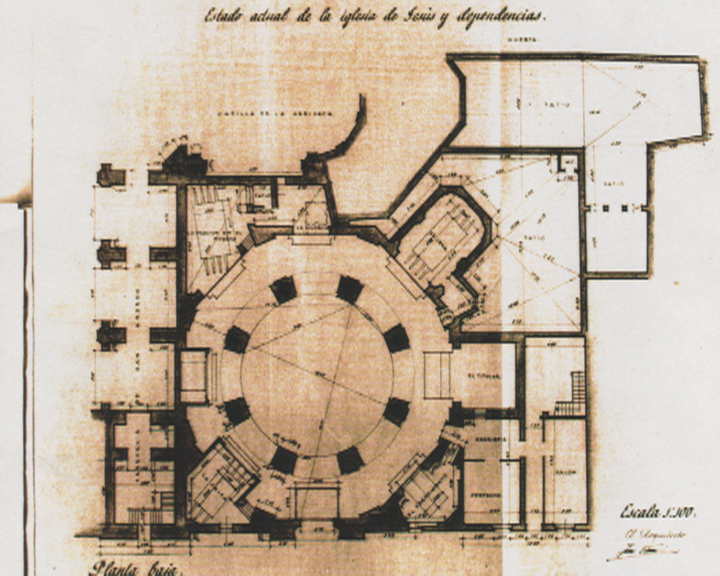
After other failed attempts during the Second Republic, the museum was finally created in 1941 by ministerial decree thanks to the initiative of the Minister of Education, Ibáñez Martín, Juan de la Cierva from the Ministry, and Emilio Díez de Revenga, in his capacity as president of the Brotherhood of Jesus.
José Tamés Alarcón, architect and conservator of monuments at the Directorate-General of Fine Arts, was commissioned to carry out the project in 1950, which was executed by Eduardo Jiménez Casalins. The works consisted of a new three-storey building and the conversion of the church for museum use.
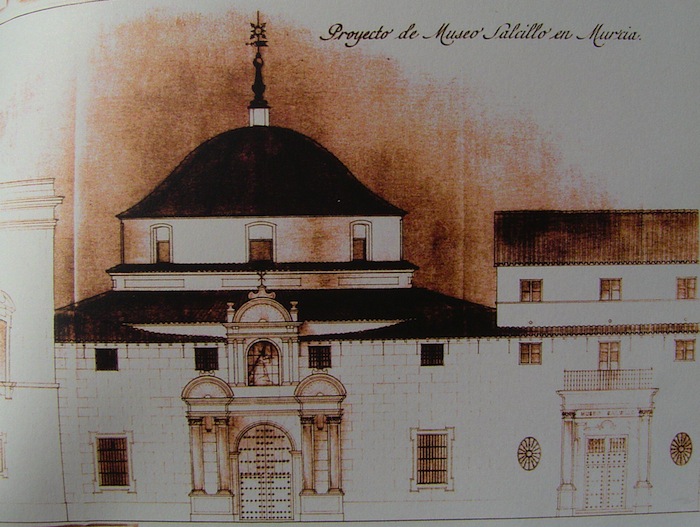
Given the poor condition of its foundations, its eight pillars were reinforced and the chapels were widened after removing the old altarpieces. Stripped of all decoration, it was easier for the public to visit the interior and for the floats to be taken out for the procession.
The entire church was decorated with faux architectural paintings by the Italian artist Paolo Sístori, but due to the poor condition of some parts and in an effort to achieve uniformity, those in the chapels were removed and the painter Mariano Ballester redid those in the dome.
In 1956, Manuel Jorge Aragoneses was appointed museum advisor by the Ministry of Education, and the nativity scene, sketches and other works by Salzillo and his school, deposited in the Provincial Museum of Fine Arts, were transferred to the new museum.
The nativity scene, consisting of more than five hundred pieces, was installed in a thirty-metre-long diorama in an L-shaped room lit by indirect overhead natural light.
