

Building
Discover the architectural features of the Salzillo Museum
Exteriors
The tour begins in San Agustín Square, the traditional forecourt of the church and museum. Completely renovated by Yago Bonet, the architect sought to regenerate the urban environment and highlight the representative and ceremonial nature of a space that once a year brings together thousands of people who come to watch the formation of the procession and the departure of Salzillo’s floats from the Church of Jesus.
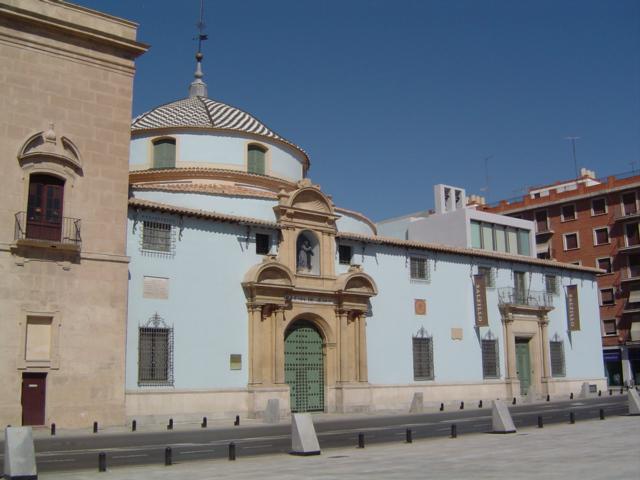
The architect has incorporated the square as the starting point of the museum tour and transformed the space into a stage for ephemeral performances and solemn traditions such as the singing of the auroros on Holy Thursday afternoon and the Baroque procession the following morning.
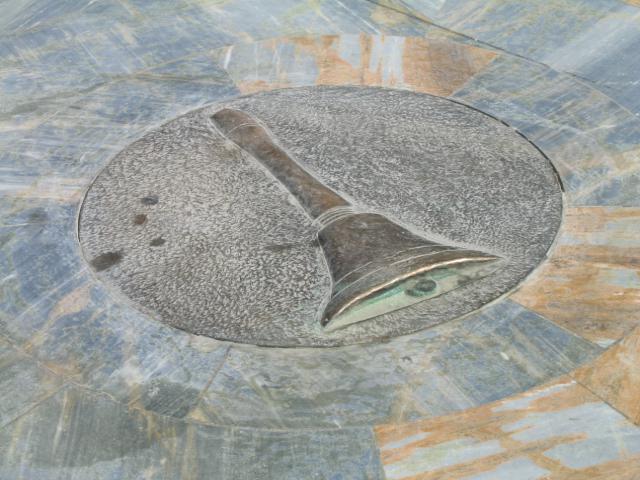
The lantern and bell, symbols carried by the auroros, have been included on the pavement of the new square.
An indigo blue now decorates the walls of the church and museum, reminiscent of the colour of the old Murcian houses, and seems to change according to the tone of the sky at any given moment, usually a bright blue toasted by the intense Mediterranean sun.
From the square, you can see the doors of its rectangular façade, which also correspond to the different extensions that have been made to the historic complex.
The façade is structured around two compositional axes, that of the church and that of the museum itself.
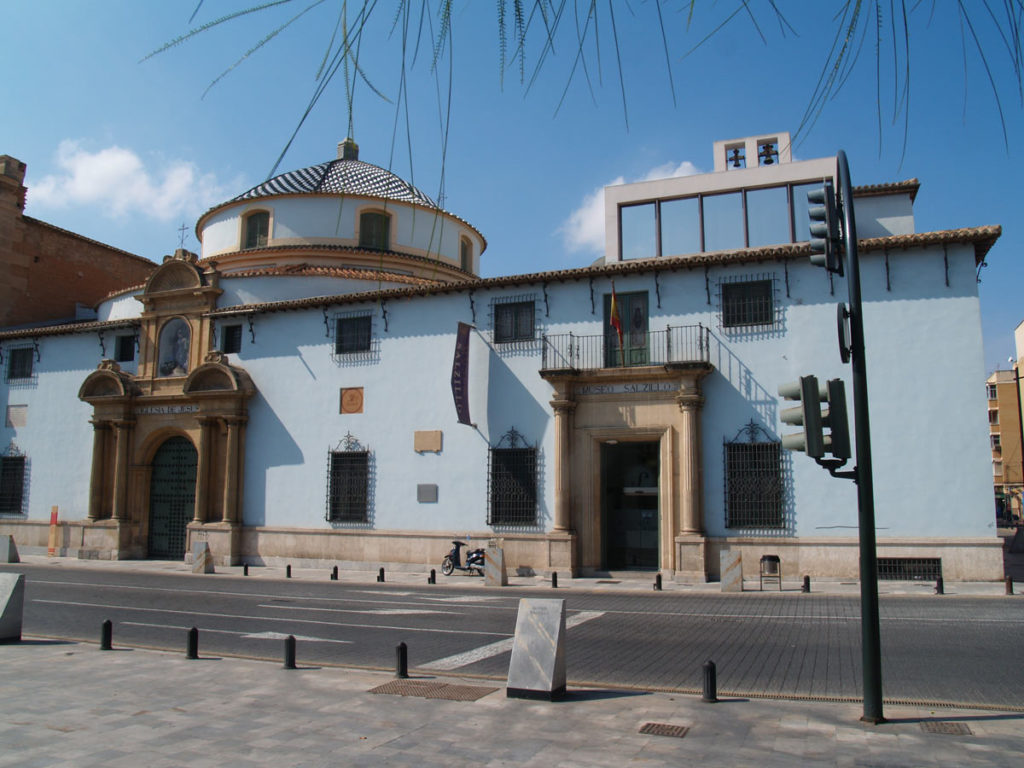
Next to the neighbouring parish church of San Andrés, the 17th-century church of Jesús stands out with its striking profile and symbolic centralised layout. Its façade was designed by Pedro de Escalante and Blas López and finally built by Francisco de Hontiyuelos in 1696.
The door is framed by two pairs of columns supporting semi-curved pediments enclosing scallop shells and topped by a small niche containing an image of Our Father Jesus Nazarene, replaced by the current stone image in the mid-18th century. Its profile stands out above the roofline and the dome drum.
A wooden cornice and wrought iron struts run along the entire façade, giving it a great deal of uniformity, as is the case with all the existing windows with wrought iron grilles in the Murcian style of the time, most of which were installed around 1950.
Next to it is the museum’s doorway, as designed by José Tamés in 1950, which follows the style of the Jesús doorway, framed by simple columns and an upper balcony. Yago Bonet has included a bell gable with straight profiles on a floor with five rectangular windows, which add a contemporary touch and provide a counterpoint to the curved silhouette of the Jesús dome.
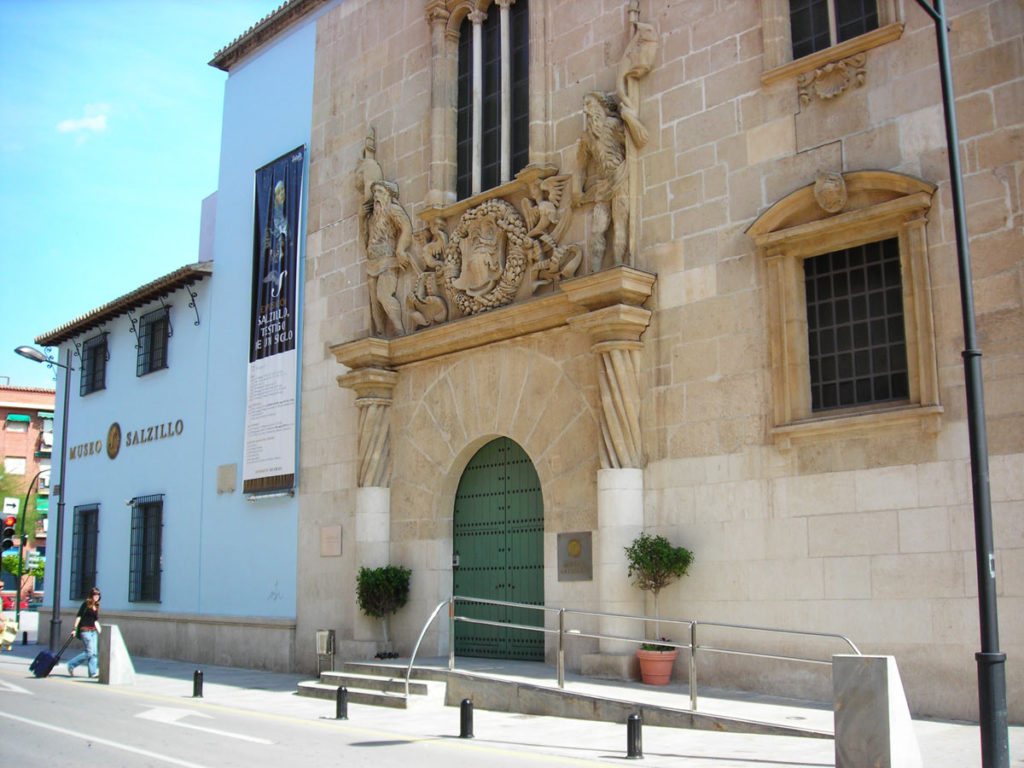
On the north side is the façade of the Riquelme Palace, installed in the Museum in the 1970s. It is now its main entrance, and with this action, Bonet has enhanced it by restoring a historical image that gives the main entrance a monumental appearance of great dignity.
The majestic semicircular arch of solid ashlars is crowned by figures of savages holding a shield with laurels and an elegant tripartite window with Ionic pilasters. The modern construction is set back to showcase and allow contemplation of the noble coat of arms between two lions on either side in the corner.
Indoor tour
The architect has completely dismantled the entire interior of the 1950s building and its rear annex to create a majestic, well-lit space thanks to its skylights, which allow for the rational use of natural light and better stabilisation of temperature and humidity conditions.
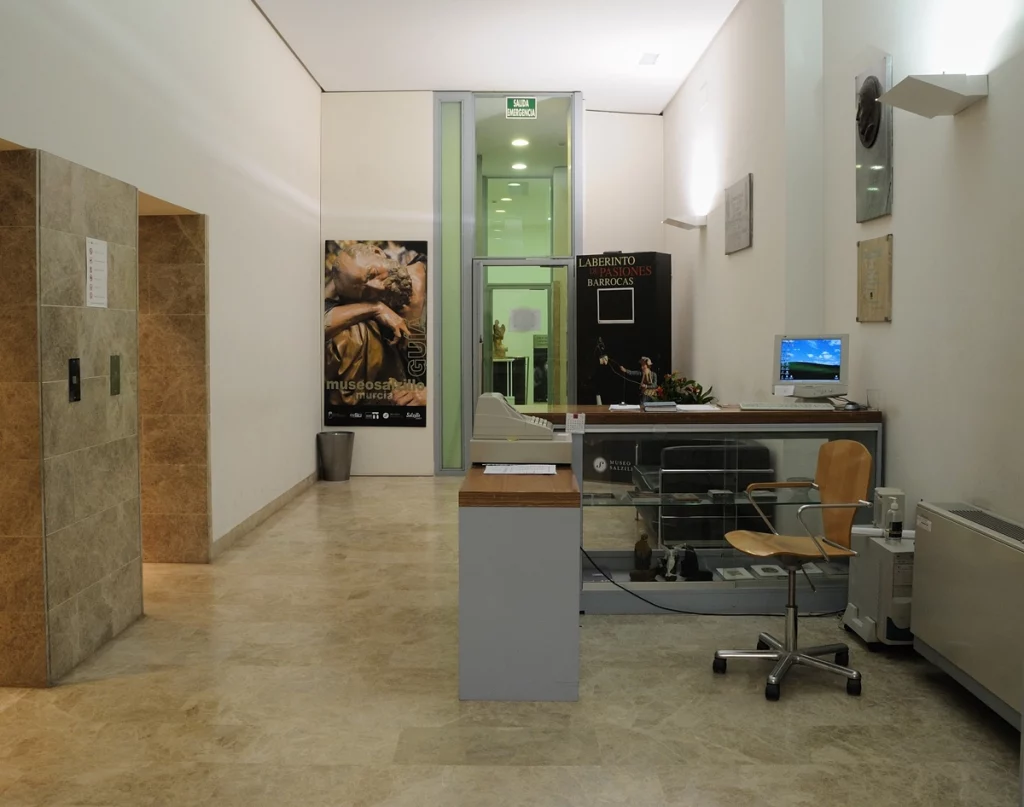
The building has been adapted to serve the museum project, with a single itinerary from top to bottom, following Le Corbusier’s plans for the Mundaneum with the aim of creating “the setting for a sacred theatre as a sculptural apotheosis”.
The tour begins on the second floor, a space dedicated to the history of the museum, where there is also a library specialising in Baroque sculpture.
Last renovation (2009)
If 2008 was characterised by anything, it was by continuing to be immersed in the transformation and remodelling works that began with the exhibition Salzillo, Witness to a Century (2007).
After the successful exhibition, it was necessary to change the exhibition discourse and improve the conditions for exhibition, conservation, storage, research and dissemination of the institution.
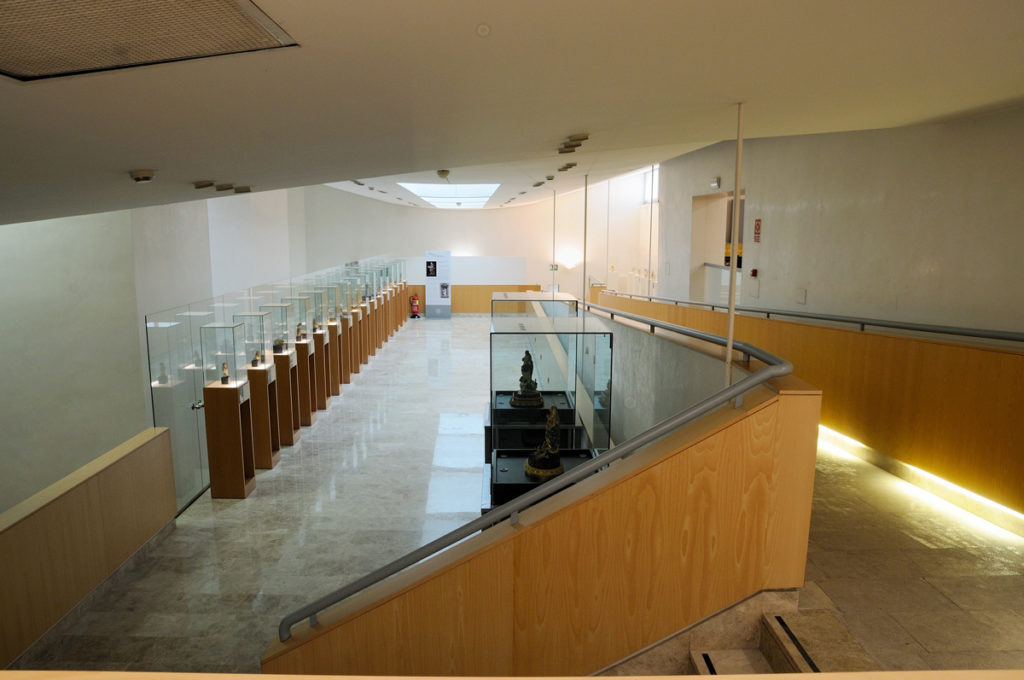
The works, based on the project by architect Pablo Puente and María Teresa Marín, began in July 2008 with some new features such as the introduction of an air conditioning system and a goods lift, improving the conditions for the conservation and exhibition of the floats in the Church of Jesús, as well as improving access to the museum for people with disabilities and facilitating the transfer of works of art from the storage areas to the exhibition areas.
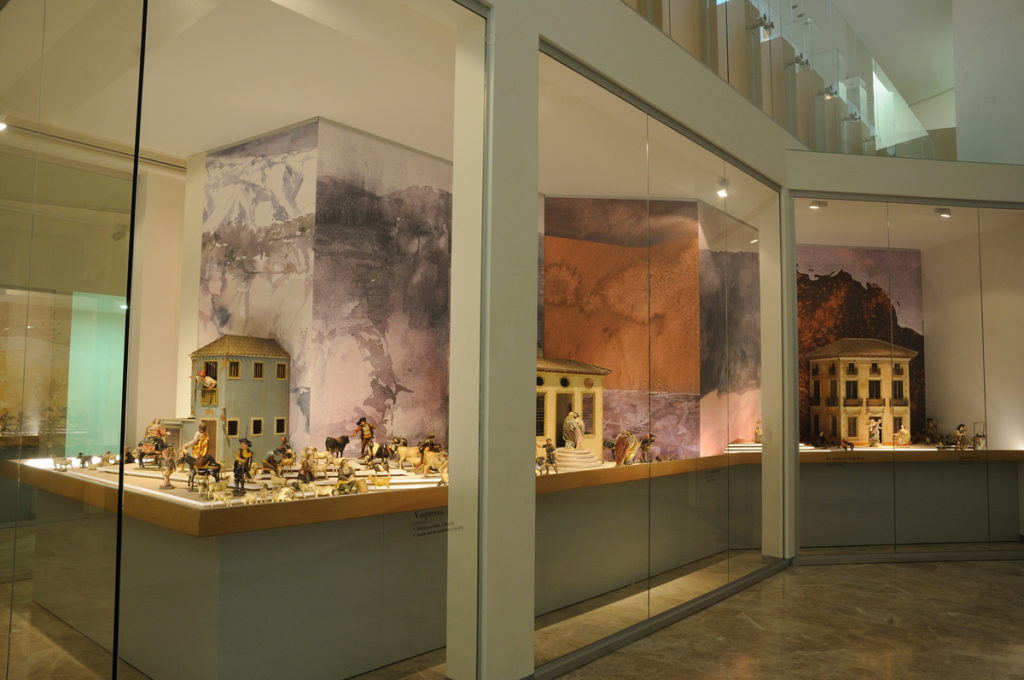
The museum redesign project not only responded to the need for better storage rooms and a new, more appropriate space for temporary exhibitions, but also to the need to improve the exhibition presentation of the collection of individual sketches and the Salzillo Nativity Scene.
The latter has regained its original narrative meaning by being displayed in a diorama.
The Church of Jesus
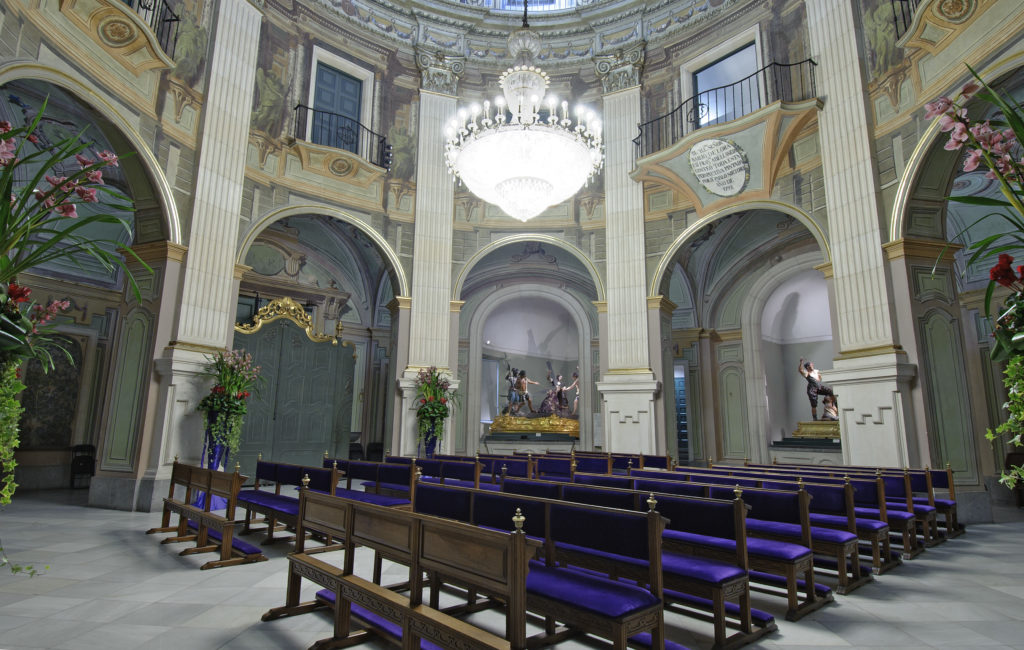
When touring the church, visitors can better appreciate Paolo Sístori’s paintings, especially those in the ambulatory, painted in tempera with architectural motifs imitating the decoration that existed prior to the church’s transformation into a museum in 1955. The paintings in the chapels were replaced by flat, monochrome decoration.
The large trompe l’oeil painted by Sístori at the end of the 18th century accentuated the theatrical nature of the setting. The gallery area retains its fake architecture and simulated marble angels intact, creating a truly illusory effect that produces sensations of reality.
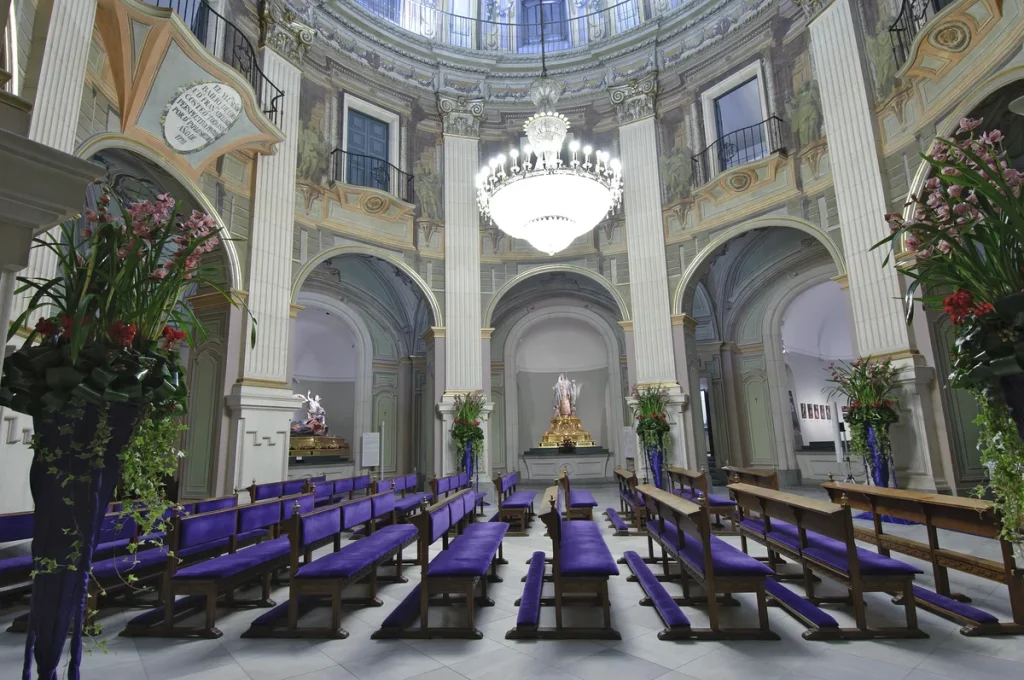
When the church was equipped with better museum conditions, a corridor was created between the chapels so that the floats could be viewed up close, giving them a new perspective.
Visitors can now view these collections in a single space, surrounded by a sacred atmosphere, in the arrangement in which they were to be kept and venerated. It is an authentic Baroque theatre dismantled once a year to parade through the city’s immense open-air theatre, illuminated by the rays of the radiant Murcian spring sun, where the moving sculptures, balanced on the shoulders of the Nazarenos, take on their true meaning.
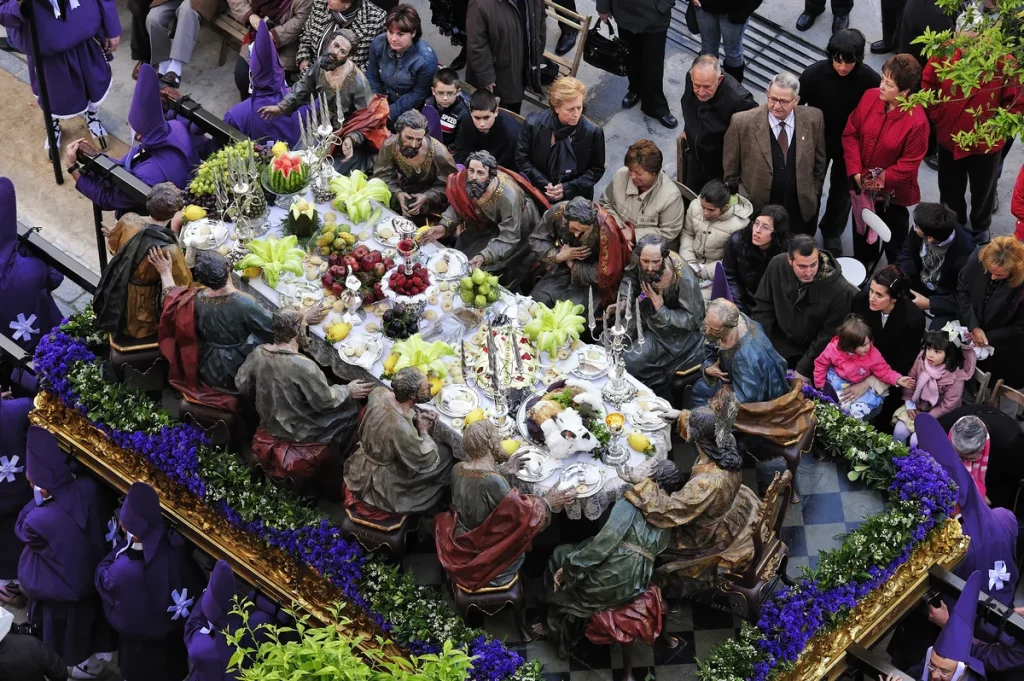
This feature is undoubtedly one of the museum’s greatest achievements, as it does not substantially alter the original function of the images, respecting tradition and ensuring that they always fulfil the purpose for which they were created. An indoor museum and a museum in the street.
Father Calatayud, a Jesuit of the time, said: ‘Worship in the home sanctifies, in the church it edifies, in the street it exemplifies’. Salzillo thus had the responsibility, through his art, as Pardo Canalís has pointed out, to ensure that “the faithful – neighbours, relatives, friends – [who] lined the streets to evoke the Passion of the Redeemer‘ could awaken in them ’compassion for Jesus, indignation towards Peter, perplexity in the Apostles, suffering with the Virgin and even hatred, why not, towards all the Judases and executioners imaginable”.
Hence the presence of anachronisms in the characters’ attire, the gradations of colour, from the rich embroidered tunics of Christ at the Last Supper or Saint Peter at the Arrest, to the reds, greens and blues of the Apostles or the yellow of Judas, an allegory of betrayal.
In Veronica or the Soldier of the Kiss, blues and pinks dominate, the same colours in which the Dolorosa was originally dressed, whose tunic and cloak were designed by Salzillo himself. The different skin tones were also quickly identified by the faithful, from the rough and rugged tanned anatomies of the executioners to the rosy and translucent white of the Angel of Prayer in the Garden.
The paintings of Sístori
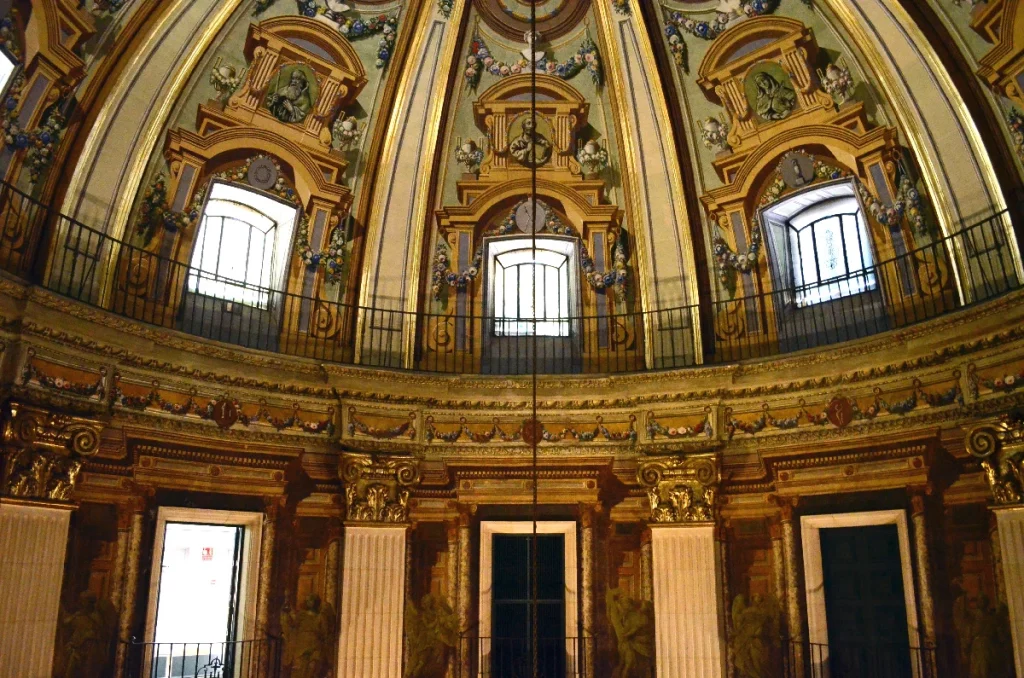
Flanking each of the eight balconies on this floor are sixteen angels bearing attributes of the Passion. The original paintings on the dome were replaced by the current ones, painted in tempera on canvas by Mariano Ballester in 1956, who also made some modifications. The original decoration simulated eight braids with oval scrolls in the centre, now replaced by clusters of flowers.
At the point where the braids converged, there was a fictitious lantern that let in the sun’s rays, but today there is a circular moulding in relief from which the central lamp hangs.
The circular medallions, white busts with garlands and eight windows framed by faux architecture simulating a pilastered portico with a curved pediment remain on the panels. The pediment originally featured Latin inscriptions alluding to the saints depicted above, which Ballester replaced with attributes of the Passion. The eight braids continue on the giant pilasters, previously painted, which run along the walls to the floor.
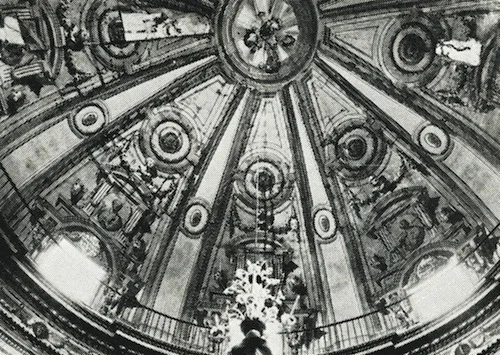
In reality, the current appearance of Sístori’s paintings has been significantly altered following various repairs carried out in the 19th century, with interventions by Carlos Marín in 1866, Mariano Ramón in 1894, and, above all, in 1955 following architectural renovations to the church.
The latest restoration was carried out by Juan Ruiz Pardo’s team from the Ministry of Culture’s Institute for the Conservation and Restoration of Cultural Property in two phases between 1996 and 1998.
